09 / Internal communications
2,300 employees. 25 schools.
A lot of people with something to say.
I write and edit internal messages, and I built the way staff send story ideas to Communications.
The hard part isn’t always writing the message. Sometimes it’s figuring out who needs it, where it belongs, and how to get the right information before the moment passes.
Working in a school district means information comes from everywhere. School staff, departments, district leadership, and people who are already juggling about fifteen other things. I help turn that information into something people can actually use.
01
The problem behind the inbox
A district this size does not have one source of news. A school has a classroom moment. A department has a process change. Leadership needs something in front of people before Friday. The people on the receiving end already have a full day.
Requests arrive in whatever shape the sender had time for. Sometimes that is a complete note. Sometimes it is “you should come see this,” with no date, no names, and no photo. By the time Communications hears about it, the moment can already be over.
The same people are also getting email, ParentSquare, website updates, and shared files. Sending one more thing to everyone is an easy way to teach them to stop reading.
02
Building a better way to collect stories
Communications cannot be in 25 buildings at once. Word of mouth was how a lot of good stories traveled, which meant we heard about some of them late, and we heard about them without the details needed to do anything.
I built a story tip form so staff could send the idea themselves, and I wrote the message that asked them to use it. A useful tip does not have to be a finished story. It has to say who it is about, where it happened, and why it stood out.
- Staff notices a storyA student, a colleague, a classroom, a program.
- They submit a tipWho it is, where it happened, a sentence or two, and a way to follow up.
- Communications reviews itWe decide whether it needs a follow-up or a coverage plan.
- The story gets developedSocial, a web story, photos, video, or a larger feature. Or not.
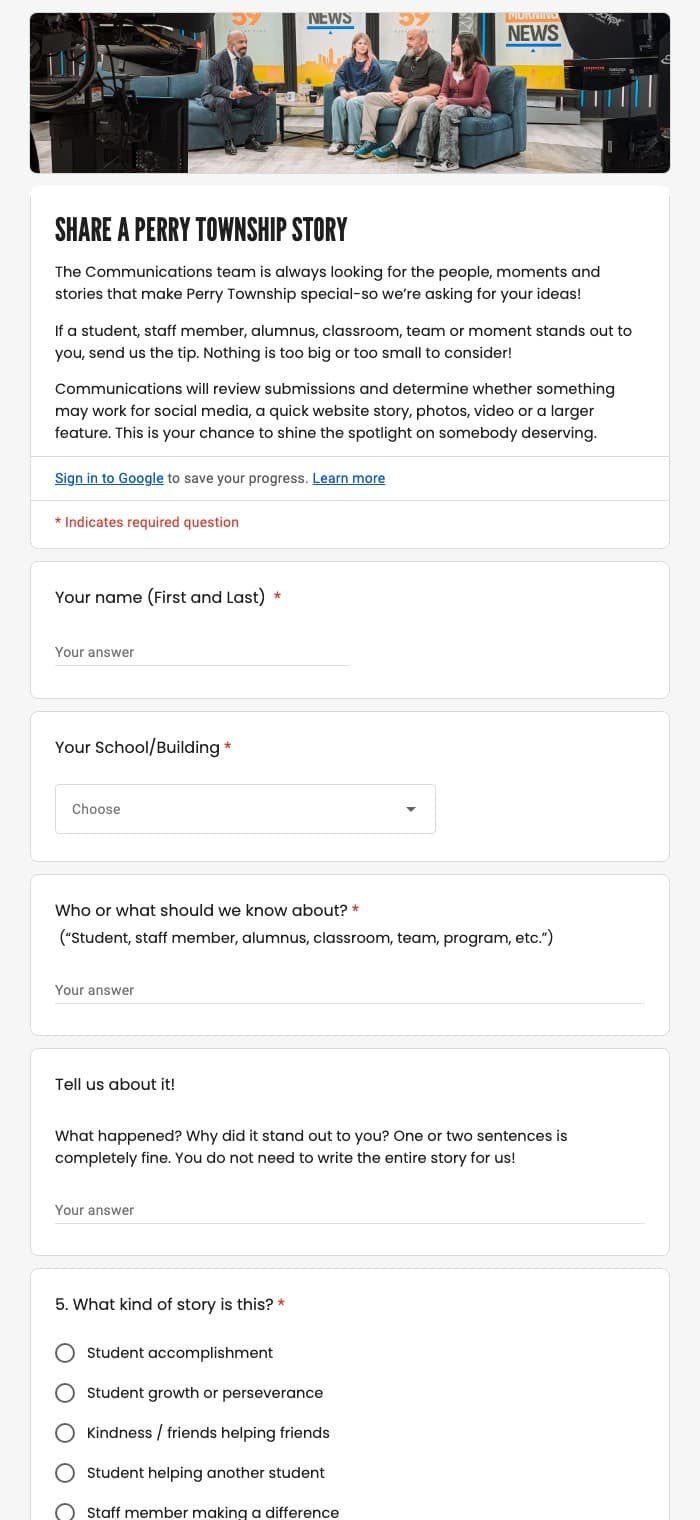
What the form asks
- Your name, and your school or building.
- Who or what the tip is about, with a prompt for a student, staff member, alumnus, classroom, team, or program.
- What happened and why it stood out. One or two sentences is enough.
- What kind of story it is, from a student accomplishment to a classroom, a club, an alumnus, or something else.
- Who to contact if Communications wants to learn more.
- Whether there are photos or video, shared as a Google Drive link, and only if they are appropriate for district use.
- How the person heard about it, and anything else Communications should know.
- Your school or buildingThe dropdown is the schools and district locations. “Our class” is not enough when there are 25 of them.
- Who, and what happenedA name or a program, plus a sentence or two. The form says staff do not have to write the story.
- What kind of story is this?Accomplishment, growth, a classroom, a team, an alumnus, and the other choices give Communications a first read on what kind of coverage might fit.
- Who to contact, and photos if they have themA teacher, coach, or staff member is enough for a follow-up. Photos and video are asked for as Google Drive links, with a reminder about student media permissions.
03
A form is only useful if people know it exists
On September 22, 2026, I published a ParentSquare announcement to staff introducing the form. The form collects the tip. The announcement tells people what kind of moment is worth sending, and where to send it.
I wrote it for staff across schools and departments. It gives examples, a direct link, and a reason to save that link for later in the year. Communications still reviews what comes back. A tip is not an automatic post.
- Examples, not a vague invitationA milestone, an alumnus, a classroom project, a team, or a person who deserves recognition gives staff something to recognize. “Send us the great things” does not.
- A direct linkSubmit Your Story Here goes to the form. Nobody has to go find Communications first.
- Save it for laterThe note at the end asks people to keep the form. The good moment is rarely the day you remember it exists.
04
Spotlight uses a different door
The story-tip form is for moments Communications might otherwise miss. Spotlight nominations are a separate form, for a student, a teacher, or a staff member someone wants recognized. The September 22 announcement did not launch Spotlight, and Spotlight’s responses do not belong to the story-tip form.
The 2025–2026 Spotlight form shows 250 responses. A response is not an approved nominee or a published feature. Before anyone is introduced, student nominations go through authorized district review and staff nominations are checked with school leadership. Those checks stay internal.
If someone moves forward, a Get to Know You post can introduce them. Interaction on that post informs who is considered for the longer video, and schools have shared the posts on ParentSquare so staff and families can find them. The creative direction and the performance questions are in the Social Media case study.
In the matched seven-month screenshot sample, the updated posts recorded 3.7× the earlier engagements. Get to Know You and voting posts were 69.3% of that updated total. The comparison, and what it does not prove, is on the Spotlight page.
05
What this set up
Staff have a place to send a story idea without waiting for someone from Communications to be in the building. The form asks for the details that make a tip actionable. The message tells them what a useful tip looks like.
I do not have adoption numbers, open rates, or a count of tips received. I am not going to invent them. What I can show is the form and the message.
- A path that does not depend on someone remembering to mention it in a hallway.
- Enough information at the start to decide whether to follow up.
- A review that still belongs to Communications. A submission is not an automatic post.
The writing still matters. It just cannot start until someone, somewhere in 25 schools, can get the right details to us in time.